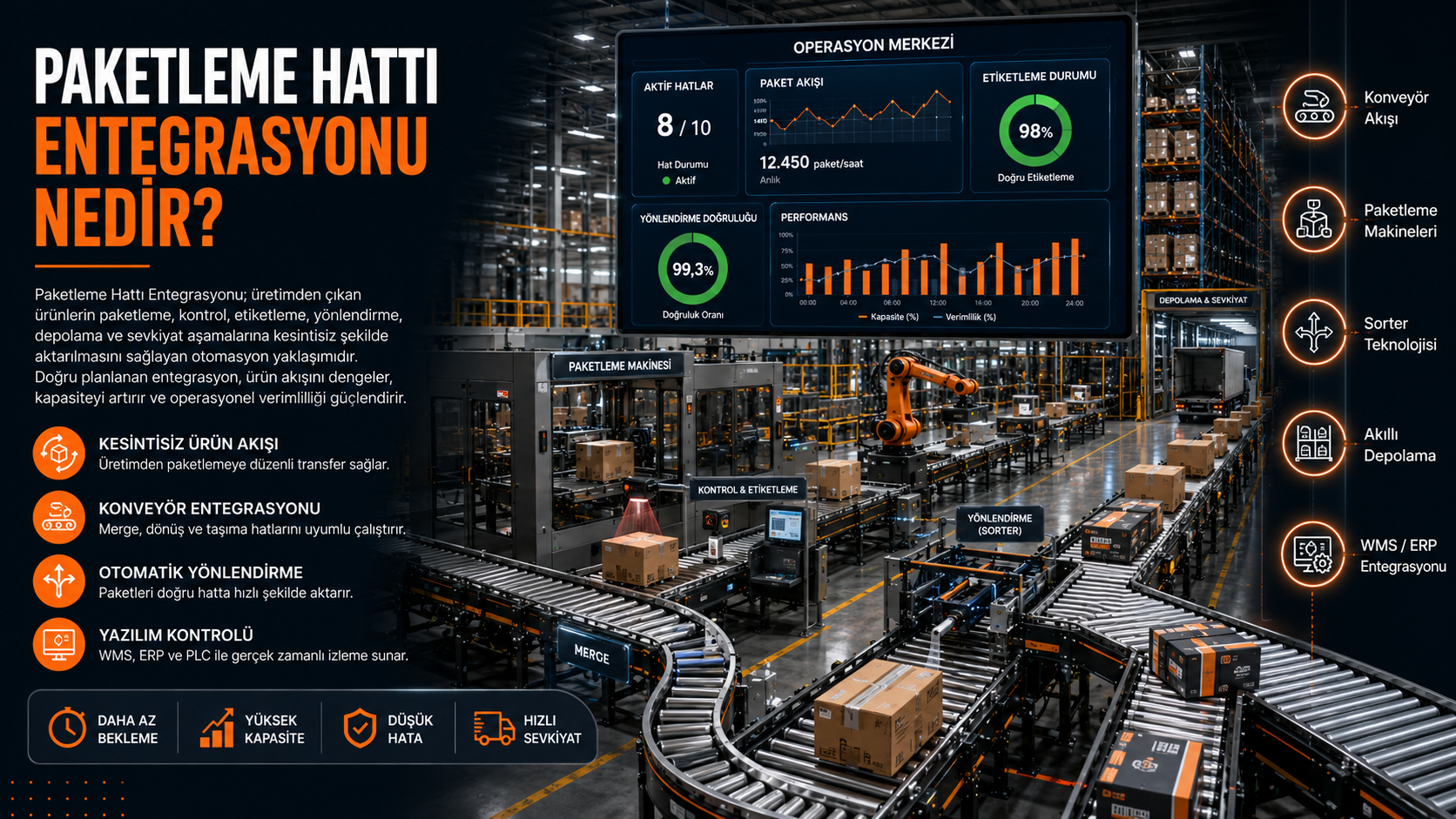
Packaging Line Integration is an automation approach that ensures the uninterrupted transfer of products from production to the packaging, control, labeling, routing, storage and shipping stages. As production capacity increases, fast operation of packaging machines alone will not be enough. Products must be moved between machines at the right time and transferred to the next operation in an orderly manner. Properly planned Packaging Line Integration increases the operational capacity of the business by combining these processes under a common flow.
Especially in facilities that produce high volumes, small waits between lines can turn into serious capacity losses over time. When conveyors, sensors, control systems and software work together, manual interventions in the packaging process can be reduced and a more balanced product flow can be created.
Why is Packaging Line Integration Important?
Even though the production line operates at high capacity, the packaging department cannot provide the same performance, which may create a bottleneck. Packaging Line Integration helps manage speed differences between production and packaging and moves products in a controlled manner.
- Product waiting times are reduced.
- The need for manual handling is reduced.
- Packaging capacity is used more effectively.
- Product flow between lines is balanced.
- Human-caused operational errors are reduced.
- The preparation process for shipment is accelerated.
This structure is especially important for operational continuity in businesses that produce continuously throughout the shift. Designing the flow in the packaging area in accordance with the production capacity directly affects the efficiency of the entire line.
Uninterrupted Product Flow from Production to Packaging
In a successful integration project, the point where the product leaves the production machine and the point where it reaches the packaging line should be evaluated together. Criteria such as product size, weight, surface structure, transport direction and hourly capacity are decisive in system design.
Correct project design of the conveyor infrastructure ensures that the products reach the packaging machines at regular intervals. In this way, unnecessary stop-start of machines can be prevented and accumulations on the line can be reduced.
How to Integrate Conveyor Systems into a Packaging Line?
In Packaging Line Integration projects, the transportation infrastructure must be compatible with the operation structure. Various conveyor solutions can be used together depending on the need for straight transportation, line combining, rotation or transfer between different processes.
In facilities where there is more than one production or packaging line, it is especially important to combine the product flow at the right point. Thanks to the appropriate conveyor combination, products from different lines can be transferred to a common line in a controlled manner.
Automatic Routing After Packaging
After packaging is completed, products may need to be transferred to quality control, storage or different shipping points. At this stage, automatic guidance systems that use barcodes and order information ensure the continuity of the operation. Thus, it is not necessary to manually determine which line the packaged product will move to.
In high-volume facilities, sorter technologies can help quickly sort different products or packages to the correct exits. Different sorter solutions can be evaluated according to operational capacity and product features.
Packaging Line Integration with Storage Systems
Waiting for packaged products at the end of the line may reduce the overall performance of the operation, even if the production capacity is high. For this reason, Packaging Line Integration should be planned to include storage processes after packaging. Automatically transferring products to appropriate storage areas both reduces the density in the field and ensures that subsequent order and shipment processes are carried out faster.
Vertical transfer solutions provide significant advantages, especially in facilities that operate on different floors. Depending on the product type and operation structure, automatic storage and floor transfer systems can work together with the packaging line.
How to Speed Up End of Line and Shipment Processes?
After the product is packaged and the necessary checks are completed, it should be transferred to the shipping area as soon as possible. Packaging Line Integration reduces the need for manual handling between production and shipment, ensuring that products reach loading areas in a controlled manner. Thus, product accumulation in the packaging department can be prevented.
Using flexible transportation systems in vehicle loading and unloading operations can also speed up the process. Appropriate conveyor solutions increase operational flexibility, especially in facilities with variable vehicle lengths and different loading points.
Control of Packaging Processes with Software Integration
A modern Packaging Line Integration does not only consist of connecting mechanical systems together. Sensors, PLC systems, barcode readers, WMS and ERP infrastructures work together to ensure real-time control of product movements. Thus, which product is packaged, on which line it moves and to which shipping point it will be sent can be tracked through the system.
Thanks to the operation data collected, line performance, waiting times and possible bottlenecks can be analyzed. This data supports not only the management of daily operations but also the more accurate planning of future capacity investments.
What to Consider When Choosing Packaging Line Integration?
The product structure, packaging method and capacity needs of each production facility are different. For this reason , Packaging Line Integration should be projected according to the actual product flow of the business, not as a ready-made equipment combination. Evaluating future production increases as well as current capacity is important for the long-term usability of the system.
- Hourly production and packaging capacity
- Product and package dimensions
- Working speeds of packaging machines
- Transfer points between lines
- Conveyor and guidance system selection
- WMS, ERP and PLC integration
- Maintenance and technical service requirements
- Future capacity increases
Packaging Line Integration, developed specifically for the business, combines product movements from production to packaging and from packaging to shipment in a common automation infrastructure. Using the right equipment and control technologies together reduces unnecessary transport movements and ensures more efficient use of line capacity. Thus, businesses can maintain operational control and continuity in product flow while increasing production speed.
You can contact us to get detailed information about packaging line integration, conveyor systems and intralogistics automation projects.
For international information on material handling and intralogistics technologies: MHI – Material Handling Industry
Related guides: What is a conveyor? Types and selection guide · How is the conveyor system cost determined? · KOAL conveyor systems

Since 2010 we have designed, built, installed and serviced sorter and conveyor systems in Gebze. These articles draw on our field experience.