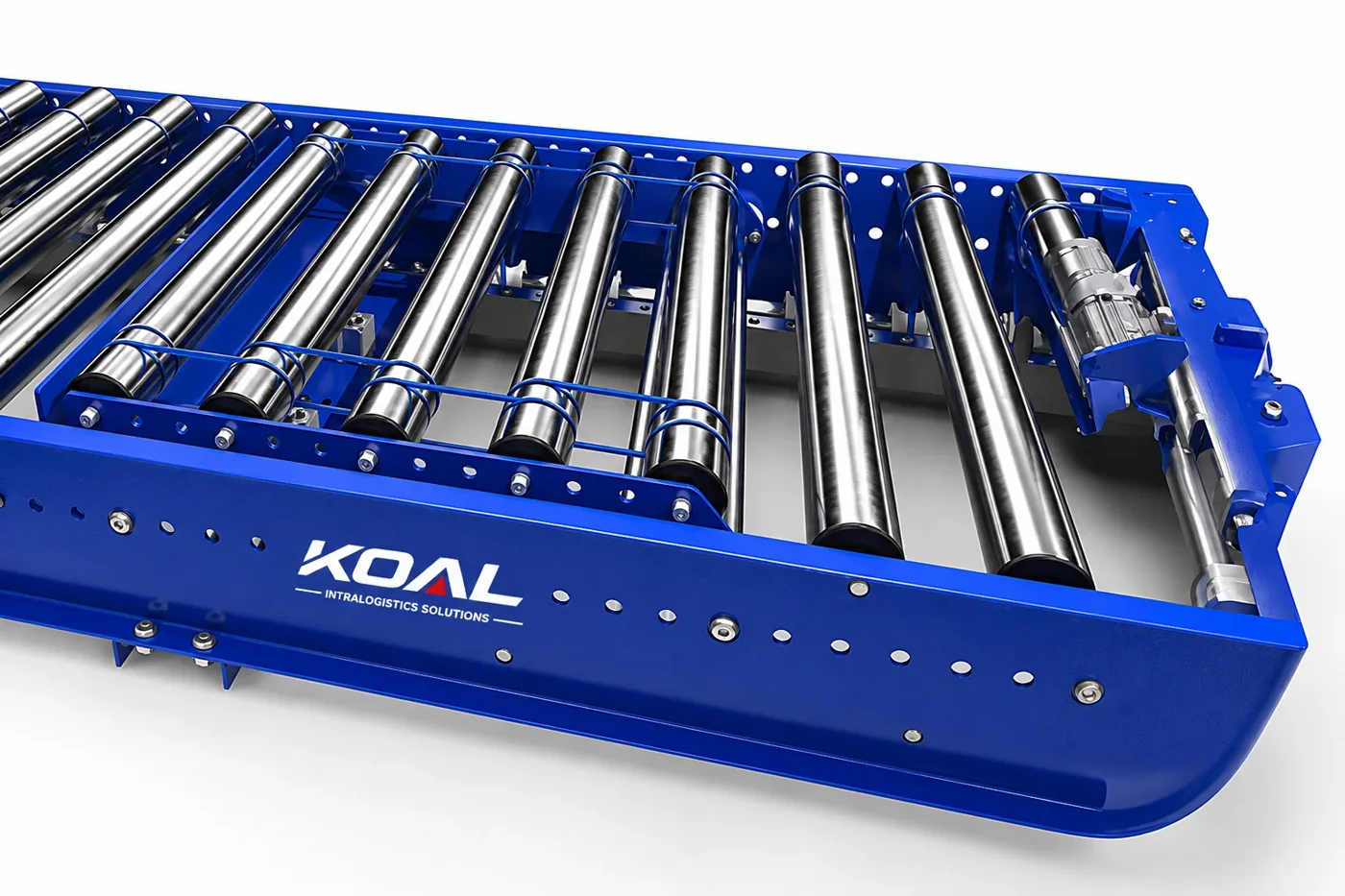

Flexible and Efficient Transport Solutions with Return Conveyors
Return Conveyors are special conveyor systems used to change direction in product transport lines. It ensures the regular transfer of products from one point to another in the areas of production, warehouse, logistics, packaging and shipping.
In areas where standard straight conveyor lines are not sufficient, the product flow must be directed to the right, left or at different angles. At this point, return conveyor systems come into play. It helps the products change direction in a controlled manner without disrupting the line order.
Return conveyors provide a great advantage, especially in businesses where space is limited. A correctly planned conveyor return line not only enables more efficient use of residential space but also makes the product transportation process more orderly.
90 Degree Rotation Belt Conveyor
It is used in different applications in many sectors such as Distribution, Logistics, Cargo, Food, Medicine and Airport. The line structure is flexible according to the project criteria, and customer-specific production is made with tape types that comply with FDA, GMP and GLP standards, upon request. Installation is quick and easy.
Technical Information
| Maximum Load Capacity | 50 Kg/m |
| Conveyor Speed | 0.1 to 1m/s |
| Working Direction | Two Way |
| Ambient Temperature | -5 to +40 °C |
Driver
| Supply Voltage | 380 V / 50 Hz / 3 Phase |
| Electric Power | Max. 3 kW |
| Engine Type | Gearmotor / Drum Motor |
| Drive roller diameter | 114 mm (cylindrical) |
| Return roll diameter | 114 mm (cylindrical) |
Materials
| Conveyor Belt | PVC coated two-layer polyester fabric, matte top, black (optional) |
| angle | 30° / 45° / 60° / 90° / 180° |
| Transport height | 1800mm |
Dimensions
| inner radius | 450mm to 1200mm |
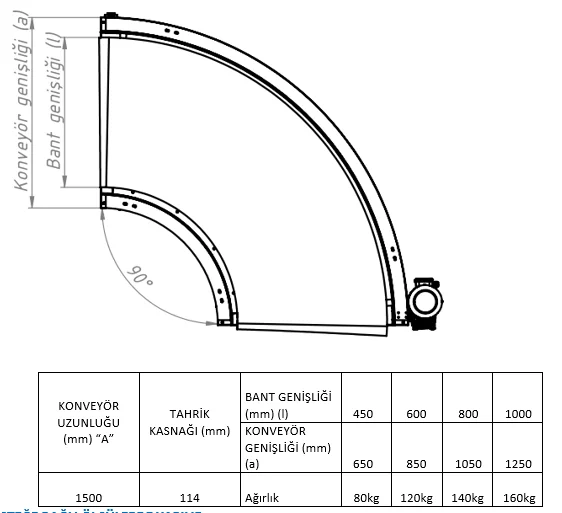
90 Degree Modular Belt Conveyor
It can be preferred in sectors such as packaging, white goods, bottle-glass, food, electrical-electronics, pharmaceuticals, logistics-cargo, machinery, automotive and textile. Modular rotating belt conveyors are extremely robust and can be used in a wide variety of areas. It has full flexibility, wear resistance and low friction and has access to a wide range of sizes, types and operating speeds. Since the tape is modular; It allows only the damaged part of the belt to be replaced in case of problems that may occur in the future.
Modular wide belt conveyor is designed for wide angle and narrow angle rotating applications such as:
Advantages of Modular Rotary Belt Conveyors;
Cold or hot, small or large; Almost all kinds of goods can be transported
Simple and fast replacement of belts and belt elements is possible thanks to individual connections
Damaged link can be replaced quickly and practically (Only the damaged part)
Ease of cleaning (washable)
- center driven
- Adjustable Foot Support Available
Technical Information
| Maximum Load Capacity | 35 Kg/m |
| Conveyor Speed | 0.1 to 1 m/s |
| Working Direction | Two Way |
| Ambient Temperature | -20 to +50 °C |
Driver
| Supply Voltage | 380 V / 50 Hz / 3 Phase |
| Electric Power | Max. 3 kW |
| Engine Type | Gearmotor / Drum Motor |
| Drive roller diameter | 114 mm (cylindrical) |
| Return roll diameter | 114 mm (cylindrical) |
| Angle a | 30° / 45° / 60° / 90° / 180° |
Dimensions
| inner radius | 450mm to 1200mm |
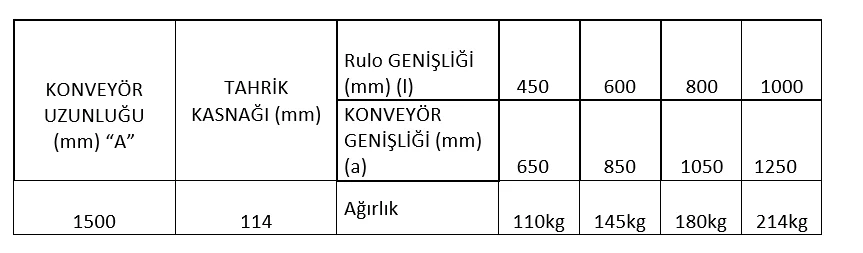
Technical Information
| Maximum Load Capacity | 50 Kg/m |
| Conveyor Speed | 0.3 to 1 m/s |
| Working Direction | Two Way |
| Ambient Temperature | -5 to +50 °C |
Driver
| Supply Voltage | 380 V / 50 Hz / 3 Phase |
| Electric Power | Max. 3 kW |
| Engine Type | Gearmotor / Drum Motor |
| Cylinder Diameter | Between Ø50 mm and Ø63 mm |
Materials
| Roller Material | Galvanized steel, conical plastic attachments |
| Angle a | 30° / 45° / 60° / 90° / 180° |
| Pi Roll range, Internal | ~72mm |
Dimensions
| SF Side guide | 65mm |
What are Return Conveyors?
Turn Conveyors are conveyor systems that enable the products to change direction at a certain angle on the transport line. It can usually be designed at different angles such as 30°, 45°, 90° or 180°. It can be produced in band, roll or modular structure, depending on the area of use and product structure.
These systems allow products to move on the line without interruption. Thus, the need for manual handling is reduced and the operation becomes more controlled.
The return conveyor is especially preferred in areas where product transfer is required between different machines within the production line. It is also an effective solution for in-warehouse routing, packaging line and shipping processes.
How Does Return Conveyor Work?
Return conveyors direct the products according to the determined angle on the conveying line. When the products arrive on the conveyor, the system moves the product through the return point in a controlled manner, thanks to its belt or roller structure.
The operating principle may vary depending on the type of system used. In banded models, products move along the surface without slipping. In roller systems, products are transported on rollers. In modular banded structures, the rotation movement is provided by a more flexible and durable structure.
The main purpose of these systems is to provide direction without stopping the product flow. Thus, the transportation line in enterprises operates more regularly, quickly and safely.
Areas of Use
Return Conveyors can be used in product transportation and guidance processes in different sectors. It has an important place especially in production line planning, warehouse layout and logistics operations.
The main areas of use are:
- Production lines
- Packaging systems
- In-warehouse transport lines
- Logistics and distribution centers
- E-commerce order preparation areas
- Food production and packaging facilities
- Pharmaceutical and cosmetic production areas
- Automotive sub-industry lines
- Cargo and shipping operations
- assembly lines
- Quality control and product transfer points
Routing products regularly in these areas reduces operation time and makes the workflow more efficient.
Which Products Are Return Conveyors Suitable For?
Return conveyor systems can be designed for different product types. The size, weight, surface structure and packaging type of the product directly affect the system selection.
Eligible product groups are:
- cardboard boxes
- parcels
- Packaged products
- plastic crates
- food packaging
- Medicine and cosmetic boxes
- automotive parts
- Electronic product packaging
- Light and medium weight industrial products
Bandwidth, rotation angle, transport speed and conveyor type can be specifically determined according to the product structure. In this way, the system can be designed in accordance with the current operation of the business.
Advantages of Return Conveyors
Return Conveyors do not only offer businesses the opportunity to change direction. It also provides significant advantages in terms of space utilization, occupational safety, speed and operational order.
Saves Space
It may not always be possible for lines to run straight in production and warehouse areas. Thanks to turning points, the product flow can be reshaped according to the available space.
This structure helps to make more efficient layout plans, especially in narrow areas. Thus, the conveying line within the enterprise becomes more compact and convenient.
Regulates Product Flow
The conveyor return line ensures that the products move in a controlled direction towards the specified direction. In this way, confusion on the line is reduced and the product flow becomes more planned.
Regular product flow reduces time loss in production and shipping processes.
Reduces the Need for Manual Handling
Manually transporting products to different points can cause both time loss and labor costs. The rotational transport system reduces manual intervention by automatically routing the products.
This alleviates the physical burden of employees and increases operational efficiency.
Makes Line Integration Easier
The return conveyor can be integrated into existing conveyor systems. It can be used to connect production machines, packaging equipment, control systems and shipping lines.
This feature helps businesses create a more efficient transportation line without completely replacing their existing infrastructure.
Provides Safe Transportation
Controlled redirection of products reduces the risk of falling, jamming or damage. A correctly designed return system contributes to the stable progress of the products.
Safe transportation is of great importance, especially for sensitively packaged products.
Return Conveyor Types
The system to be used at turning points should be determined according to the product type and operational needs of the business. Different types of conveyors offer different advantages.
Belt Return Conveyor
The banded structure ensures more stable transportation of products on the surface. It can be preferred for routing parcels, packages, boxes and packaged products.
It is an effective solution in areas where products must move without slipping.
Roller Return Conveyor
Roller systems are especially used to transport flat-bottomed products. It is suitable for products such as parcels, cases and boxes.
It can be designed with free roll or motor driven options. Depending on the intensity of the operation, manually assisted or automatic working structure may be preferred.
Modular Belt Return Conveyor
Modular band systems stand out with their durable structure and flexible usage advantage. It can be used in food, packaging, production and logistics lines.
It is easy to clean and can adapt to different types of products.
90 Degree Turn Conveyor
90 degree conveyor systems are used in lines where products must change direction at right angles. It is frequently preferred in warehouse layout, machine connections and packaging areas.
It is an effective solution to optimize space usage.
180 Degree Rotation System
The 180 degree rotation structure is used in lines where products need to be transferred in the opposite direction. It may be preferred to redirect product flow, especially in production or control processes.
Technical Specifications
Technical specifications of return conveyor systems may vary depending on the project need. Product structure, carrying capacity, line height and rotation angle are the determining factors in system design.
Technical criteria that can be generally evaluated are as follows:
| Feature | Explanation |
|---|---|
| Turning Angle | 30°, 45°, 90° or 180° options |
| Conveyor Type | Tape, roll or modular tape structure |
| Working Direction | One way or two way |
| Carrying Capacity | Projected according to product type |
| Tape/Roll Width | Determined according to the need for surgery |
| Chassis Structure | Steel or stainless steel options |
| Engine System | Gearmotor or drum motor options |
| Control Structure | Manual, automatic or sensor-assisted control |
| Area of Use | Production, warehouse, logistics, packaging and shipping lines |
Correct determination of technical details is important for the system to operate efficiently for a long time.
What to Consider When Choosing a System?
When choosing a return conveyor, not only the rotation angle but also the entire operation structure should be evaluated together. Improperly planned systems may cause slowdowns in product flow or routing errors.
Product Size and Weight
The size, weight and base structure of the products to be transported are important for system selection. While a roller structure may be suitable for flat-bottomed boxes, a banded structure may be preferred for more sensitive or smaller products.
Turning Angle
The angle at which the product will change direction must be clearly determined. 90 degree rotation systems are one of the most common solutions. However, on some lines, a 45 degree or 180 degree rotation structure may be more appropriate.
Line Speed
The speed of the conveyor line must be suitable for the production or shipment capacity. Systems that are too slow can become bottlenecks. In very fast systems, product stability must be carefully evaluated.
Field Layout
The area where the system will be installed should be planned taking into account the existing machines, loading points and operator movement area. Correct placement is important for both safety and efficiency.
Need for Integration
The return system must work in harmony with the existing conveyor line, automation system, sensors or production equipment. If the integration plan is made correctly, the product flow becomes uninterrupted.
Benefits to Businesses
Return Conveyors provide businesses with many operational advantages in product transportation processes.
The main benefits are:
- Regulates product flow
- Optimizes space usage
- Reduces the need for manual handling
- Speeds up the product orientation process
- Facilitates line-to-line connection
- Increases operational efficiency
- Reduces risk of product damage
- Provides a more streamlined production and shipping process
- Can be integrated into existing conveyor systems
- Can be specially designed for different sectors
These advantages create a more controlled and sustainable operation structure, especially in businesses with intense product flow.
Maintenance and Long-Term Use
Regular maintenance is required for conveyor systems to operate for a long time. Since moving parts work more actively at turning points, control processes should not be neglected.
Things to consider during the maintenance process:
- Tape or rolls should be checked regularly
- Motor and reducer connections should be examined
- Chassis connections should be checked
- Sensors and control equipment must be tested
- The product guiding surface must be kept clean
- Moving parts should be checked periodically
- Operators should be trained in correct use
Regular maintenance maintains system performance and prevents unplanned downtime.
Technical Support and Communication
You can contact our expert team to get detailed information about Return Conveyors, to determine the suitable conveyor return line for your business, or to evaluate the solution that can be integrated into your existing systems.
A system design specific to your project can be made according to details such as product type, carrying capacity, rotation angle, bandwidth, working area and operation intensity.
You can contact us via our contact page to get detailed information.