Short answer: Sorter in warehouses, logistics and distribution centers; It automatically separates products according to store, dealer, route or vehicle, from receipt to shipment. Sorter type is selected according to warehouse volume, product size and number of outlets.
Sorter Systems for Warehouse are intralogistics automation solutions that enable parcels, packages, boxes and different products to be automatically sorted according to predetermined criteria and directed to the correct exit points. Particularly in e-commerce warehouses, distribution centers and high-volume logistics facilities, manual sorting of products can limit operational capacity. Thanks to correctly selected sorter technology, product flow can be automated and many processes, from order preparation to shipment, can be managed in a more controlled manner. Sorter systems generally work with conveyors, sensors, barcode readers, PLC control infrastructure and warehouse software. When the product enters the system, its identity or target information is determined. The control system evaluates this data and decides which output the product will be transferred to. Thus, Sorter Systems for Warehouse can combine physical product flow with digital order and shipment data in the same automation process.
Why is Sorter System Used in Warehouses?
In warehouses where thousands of products move during the day, it may require a significant amount of labor to check each parcel or package and separate it to different points by employees. Additionally, as operational volume increases, it may become difficult to maintain the speed and accuracy of manual sorting processes. Sorter Systems for Warehouse help to perform repetitive sorting operations automatically. Products entering the system can be separated according to order, customer, region, cargo company, shipping door or different operation criteria.
- Helps reduce the need for manual product sorting.
- Supports high volume product flow.
- It can speed up order preparation processes.
- Supports transferring products to correct exits.
- It makes product movements within the warehouse more traceable.
- It facilitates the organization of shipping operations.
How Does Sorter System Work?
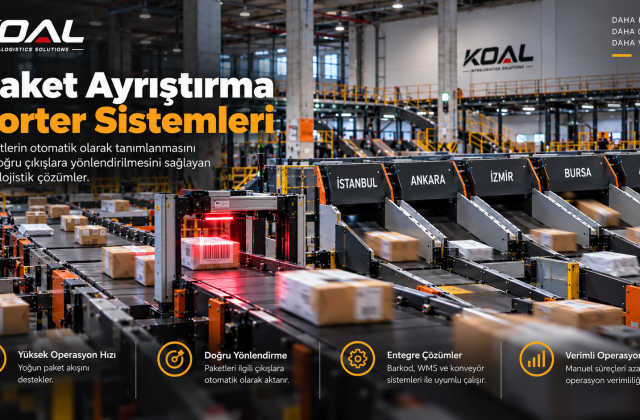
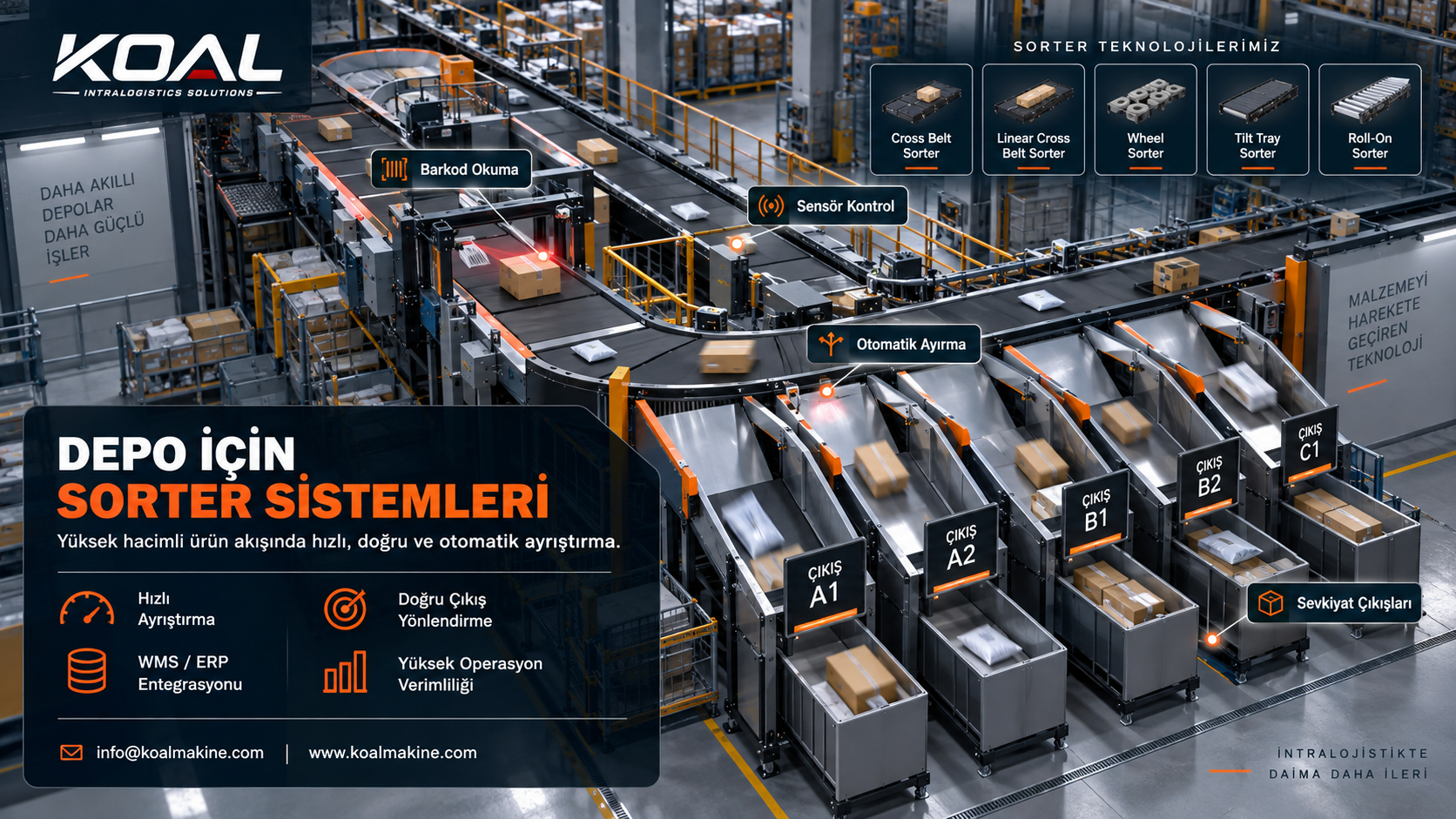
Sorter operation starts with the acceptance of the product into the system. The product taken onto the conveyor line is detected by barcode reader, sensor or other identification technologies used. The obtained information is transmitted to the control system and the target output defined for the product is determined. When the product reaches the target point on the sorter, the system activates the appropriate sorting mechanism. Depending on the technology used, the product may be transferred to the side, directed to a separate belt, or dropped into the designated exit channel. Sorter Systems for Warehouse can perform this process sequentially and automatically for a large number of products.
Which Sorter Systems Can Be Used for Warehouses?
It is not correct to use the same sorter technology in every warehouse operation. Product size, weight, packaging structure, hourly target capacity, number of outlets and facility layout should be evaluated in system selection. KOAL Makine has sorter solutions for different operational needs.
Cross Belt Sorter
Cross Belt Sorter is one of the high-capacity sorting solutions that can transfer products to designated exits via independent belts on carriers. It can be used in distribution and e-commerce operations where there are many exits.
Linear Cross Belt Sorter
Linear Cross Belt Sorter enables automatic sorting of products into different outputs in operations requiring linear layout. It can be used as part of a sorter project depending on the facility geometry and product flow.
Wheel Sorter
Wheel Sorter enables the transfer of products from the main transport line to different exits with wheel mechanisms that can change direction. It can be used in high-tempo flows of parcels and packages with suitable base structure.
Tilt Tray Sorter
Tilt Tray Sorter is a sorter technology in which products move on carrier trays and are sorted by tilting the tray when the target output is reached. It can be preferred in different distribution applications depending on product profile and operational requirements.
Roll-On Sorter
Roll-On Sorter is one of the sorter solutions that can be used to meet the need for automatic sorting in certain product and operation types. When choosing a system, product features, capacity and target output structure should be evaluated together.
Integration of Sorter and Conveyor Systems
Sorter should be considered as a part of the material flow in the warehouse, not as a stand-alone piece of equipment. Appropriate conveyor infrastructure is needed to regularly deliver the products to the sorter entrance and to transport the sorted products to the next operation points.
A more balanced product flow can be created when conveyor speeds and distances between products are planned in accordance with the sorter capacity. For this reason, it is important to consider the sorter, conveyor, sensor and control infrastructure as a whole when designing Sorter Systems for the Warehouse.
Sorter Integration with WMS and ERP
In modern warehouse operations, simply physically separating products is not enough. The system must know which product belongs to which order, customer, shipping region or carrier. Therefore, Sorter Systems for Warehouse can be used by integrating with business software such as WMS and ERP. For example, when the barcode of a parcel entering the sorter line is read, the product information can be matched with the order data on WMS. The control system can determine the target output and transfer the necessary steering command to the sorter equipment. After the parsing process is completed, the new operational status of the product can be sent back to the software system. Thus, the coordinated progress of physical product movements and digital warehouse records is supported.
Using Sorter in Order Preparation Processes
Many orders may need to be prepared at the same time in e-commerce and distribution centers. Separating the products coming from the collection areas according to orders, stores, regions or other operation criteria is one of the important stages of this process. Sorter Systems for Warehouses help create automatic sorting processes in facilities with high order volume. The collected products can be transferred to a common conveyor line and sent to the sorter system after passing through the identification point. The system can direct each product to the relevant exit and ensure that it is transferred to the next packaging or shipping stage. Thus, reducing the density that may occur at manual separation points is supported.
Sorter Integration with Automated Storage Systems
Sorter systems can work with automated storage technologies to automate a larger portion of the material flow within the warehouse. The cases or boxes coming out of AS-RS Mini Load Systems can be transferred to conveyor lines and sent to the sorter system according to the need for the next operation. Case Pallet Elevators can be used when product transfer is required between different floors or working levels. Thus, storage, vertical transfer, transportation and sorting processes can operate in an interconnected automation infrastructure.
Sorter Systems in Shipping Operations
The shipping area is one of the operation points where the use of Sorter Systems for Warehouse is important. Prepared parcels and packages may need to be divided into different cargo companies, routes, regions or loading gates. The sorter system can transfer packages to the appropriate exits using the product ID and destination information defined in the system. After the sorted products are delivered to the vehicle loading area , Telescopic Conveyors can be used in loading and unloading operations. In areas that require more flexible transportation , Accordion Conveyor ( KOALFLEX ) solutions can be evaluated.
What Should Be Considered When Choosing Sorter Systems for Warehouses?
Sorter selection should not be based solely on the maximum capacity of the system. Product structure, warehouse layout and current operation flow should be evaluated together. In order to choose the right Sorter Systems for Warehouse, it is important to perform capacity and product analysis on real operation data.
- Minimum and maximum dimensions of the products should be determined.
- The product weight range should be analyzed.
- Product volume in hourly and peak periods should be calculated.
- The required number of sorter exits must be determined.
- Packaging and base features of the products should be examined.
- Current warehouse layout and available space should be evaluated.
- WMS, ERP and control system integration should be planned.
- Future capacity increases should be taken into account.
Correctly designed Sorter Systems for Warehouse; It helps manage the product flow in a more controlled manner by working with conveyors, barcode readers, sensors, automation software and storage equipment. When choosing between Cross Belt, Linear Cross Belt, Wheel, Tilt Tray or other sorter technologies, the actual operation needs of the facility should be taken into account. Thus, an automation infrastructure can be created that not only meets the current capacity but also can adapt to the growing warehouse operation in the future.
You can contact us to get detailed information about warehouse sorter systems, conveyor automation and intralogistics projects. Contact Via WhatsApp You can review MHI – Material Handling Industry resources for international sectoral information about material handling and intralogistics technologies.
Sorter use in logistics and distribution centers
- Store and dealer shipping: separation of products by store in retail distribution centers
- Separation by route and vehicle: loading order by vehicle on the shipping dock
- Guidance in receiving goods: distribution of incoming parcels to storage areas
- Cross-dock: transfer from storage directly to the exit line
| Sorter type | Capacity (pieces/hour) | Max. weight | Max. product size |
|---|---|---|---|
| cross belt | 8,000–14,000 | 35kg | 600×400×380mm |
| Tilt tray | 6,000–12,000 | 35kg | 600×400×380mm |
| wheel sorter | 2,500–5,000 | 50kg | 1000×800×800mm |
| narrow belt | 1,800–2,750 | 50kg | 900×600×600mm |
| Roll-on | 1,600–2,400 | 35kg | — |
Frequently asked questions
What does sorter do in the distribution center?
It speeds up shipment preparation and reduces incorrect loading by automatically separating incoming and outgoing products according to store, dealer, route or vehicle.
How much space is required to install sorters in the warehouse?
Area; Varies depending on sorter type, number of exits and feeding points. In narrow areas, compact solutions such as vertical cross belt sorters are evaluated.
Related guides: Cross belt or tilt tray? Comparison of sorter types · 10 questions when choosing a sorter system · KOAL sorter systems

Since 2010 we have designed, built, installed and serviced sorter and conveyor systems in Gebze. These articles draw on our field experience.