Barcode Routing System is an automation solution that enables the barcode information of parcels, packages, cases or products moving in warehouses, production and distribution centers to be automatically read and directed to the specified target point. In high-volume operations, manually checking the products and transferring them to the correct line can cause both time loss and routing errors. A correctly designed Barcode Routing System brings together product identity and physical product flow, allowing operations to be carried out in a more controlled manner. The system is basically based on the interoperability of barcode readers, sensors, conveyors, PLC control infrastructure and guidance equipment. By comparing the read barcode information with the data in WMS, ERP or related control software, it can be determined to which point the product will be sent. Thus, products can be moved within the warehouse, reducing the need for manual decision-making.
Why is Barcode Routing System Important?
In e-commerce and logistics operations, many different orders or products may pass through the same line. Every package must arrive at the correct fulfillment, storage or shipping point. Barcode Routing System helps make the correct routing decision by checking the identity of the product during the physical flow.
- It enables automatic identification of products.
- Reduces the need for manual guidance.
- It helps reduce products sent to the wrong line.
- It accelerates the order and shipping processes.
- Increases traceability of product movements.
- It facilitates the management of high-volume operations.
Automatic identification and routing infrastructure provides a significant advantage, especially in facilities where different carriers, shipping routes or order groups are in the same operation.
How Does Barcode Routing System Work?
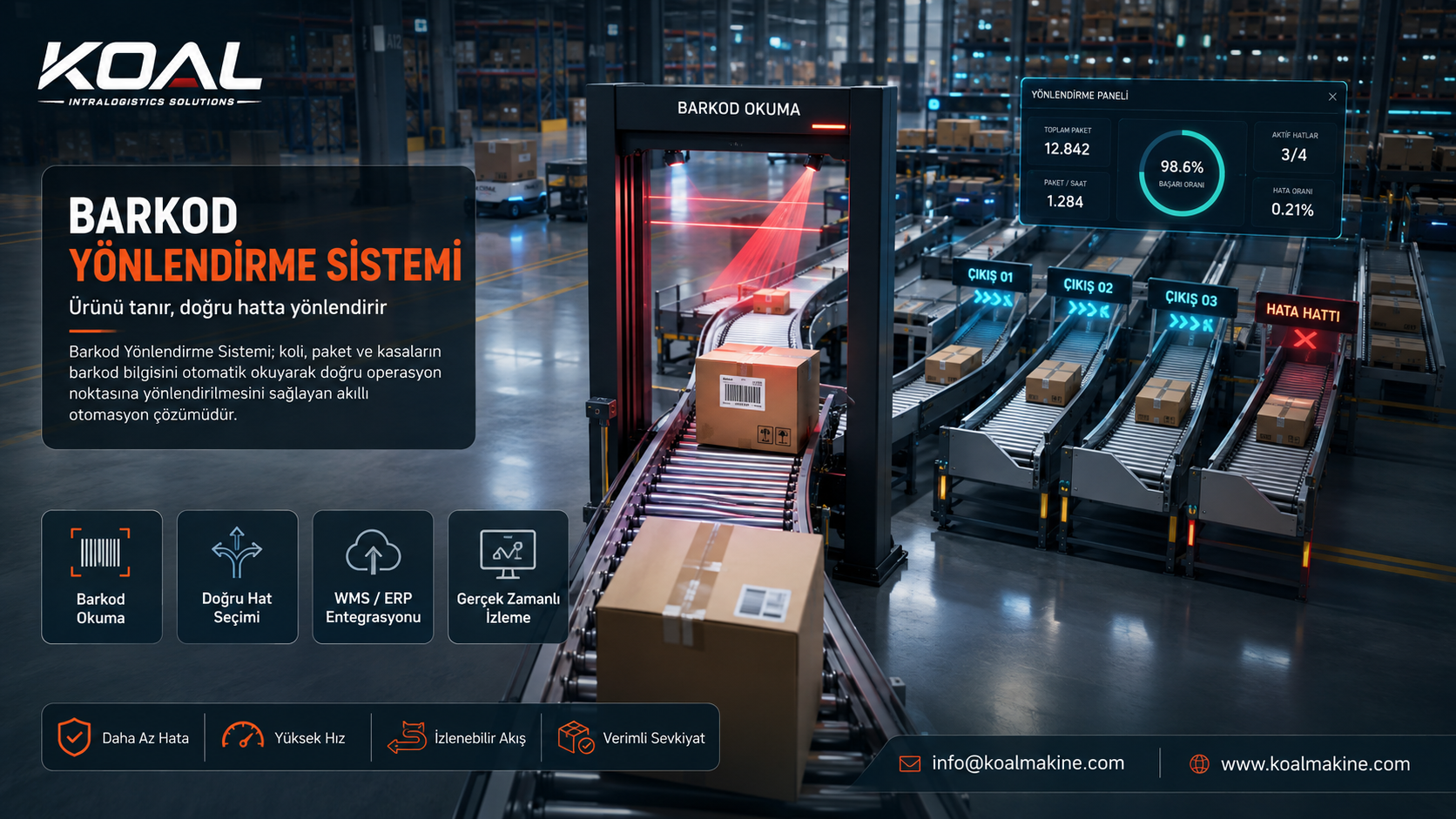
When the product reaches the barcode reading point on the conveyor line, the code on it is detected by the automatic reader. The read information is transferred to the control software and the target point of the product registered in the system is determined. Then, the Barcode Guidance System sends the necessary command to the relevant conveyor or guidance equipment, ensuring that the product moves on the correct line. After the routing is completed, the new location of the product can be saved in the system. Thus, the movement of the product within the warehouse can be tracked at different operation points. In cases where the barcode cannot be read or a match cannot be found in the system, the product can be directed to the control or error line.
Barcode Routing with Conveyor Systems
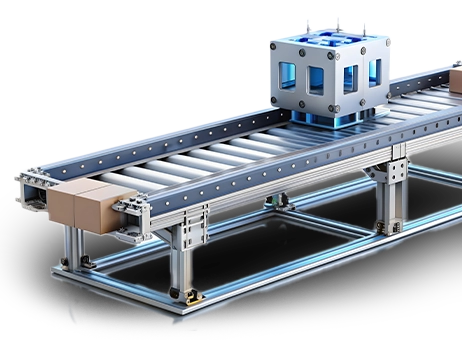
For a successful Barcode Routing System, products must be regularly transported to barcode reading and routing points. For this reason, the conveyor infrastructure should be selected by taking into account the product size, weight, base structure and required hourly capacity.
Correct conveyor design helps products pass in front of the barcode reader at the appropriate speed and position. Thus, while reading performance is supported, the products are regularly transferred to the next forwarding point.
Automatic Sorting with Sorter Systems
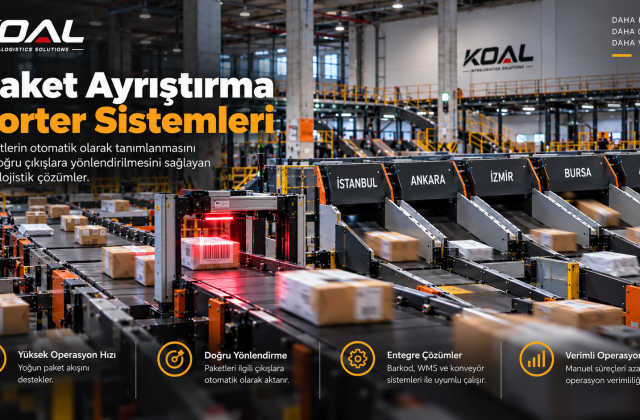
In high-volume operations, products identified by barcode may need to be directed to many different exits. At this point, the Barcode Routing System can be integrated with sorter technologies to create an automatic sorting process. According to the barcode data, it is determined which exit the product will be transferred to and the sorter performs the relevant routing process.
When choosing a sorter, it is not only the number of exits; Product dimensions, weight range, target capacity and existing facility layout should also be evaluated. Thus, a seamless automation flow can be established between barcode reading and physical separation.
Barcode Integration with WMS and ERP Systems
Integrating barcode routing operations with warehouse management software enables physical product movements to be matched with digital data. Barcode Routing System can determine which operation point the product should be transferred to by using the order, stock, customer and shipment information on WMS or ERP. For example, when a parcel passes through the barcode reading point, the order number of the product can be queried through the system. Once the shipment gate or carrier information for the relevant order is determined, the control system can direct the product to the appropriate line. When the transaction is completed, transaction information can be transferred back to WMS or ERP system. Thus, the coordinated progress of physical product flow and digital records is supported.
Barcode Tracking in Automated Storage Systems
Barcode technology can be used not only in shipping and sorting processes but also in automatic storage operations. When the product enters the system, identification information can be determined by reading its barcode and an appropriate storage task can be created. While the conveyor system transports the product to the relevant transfer point, automatic storage equipment can handle the next movement. AS-RS Mini Load Systems can be used especially in case and box based automatic storage operations. Case Pallet Elevators can be included in the general automation flow for product transfers between floors or different levels. Thus, the Barcode Routing System helps manage transportation and storage processes through a common product identity.
Barcode Routing System in Shipping Areas
Shipping operations are one of the most important uses of barcode-based automatic routing. Prepared packages may need to be sent to different vehicles, carriers, regions or shipping gates. Barcode Routing System reads the code on the package and ensures that the appropriate destination is determined according to the shipment information defined in the system. After the products are delivered to the loading area , Telescopic Conveyors can help reduce the loading and unloading distance in the vehicle. When there is a need for more flexible transportation in the operation area, solutions such as Accordion Conveyor ( KOALFLEX ) can be used.
Real-Time Product Tracking and Traceability
Data obtained from barcode reading points makes it easier to track the movements of the product within the operation. Readings made at different stages such as system entry, sorting, storage, order preparation and shipment can be recorded. Thanks to this structure, it can be monitored at which point the product passed and to which target it was directed. Collected operational data can also be used to analyze system performance. Operation points that need to be improved can be determined by examining indicators such as the amount of products read per hour, successful routing rate, number of unreadable barcodes and line density.
What Should Be Considered When Planning a Barcode Routing System?
Since the product profile and operational capacity of each facility is different, existing processes must be analyzed in detail when designing the Barcode Routing System. In addition to barcode reader selection, the conveyor speed, the position of the products on the line and the capacity of the routing equipment should be evaluated together.
- Determination of product and package dimensions
- Analyzing barcode type and label location
- Calculation of hourly target product capacity
- Positioning barcode readers at the right points
- Determination of conveyor speeds according to operational needs
- Planning WMS and ERP data integration
- Creating error scenarios for unreadable barcodes
- Considering future capacity increases
A properly designed Barcode Routing System combines product identification and physical material flow in a common automation structure. Coordinated operation of conveyors, sorter systems, barcode readers and control software; It helps manage storage, order preparation and shipping operations faster and more traceably.
You can contact us to get detailed information about barcode routing, conveyor automation and intralogistics system projects. Contact Via WhatsApp You can review MHI – Material Handling Industry resources for international sectoral information about material handling and intralogistics technologies.
Related guides: Cross belt or tilt tray? Comparison of sorter types · 10 questions when choosing a sorter system · KOAL sorter systems

Since 2010 we have designed, built, installed and serviced sorter and conveyor systems in Gebze. These articles draw on our field experience.