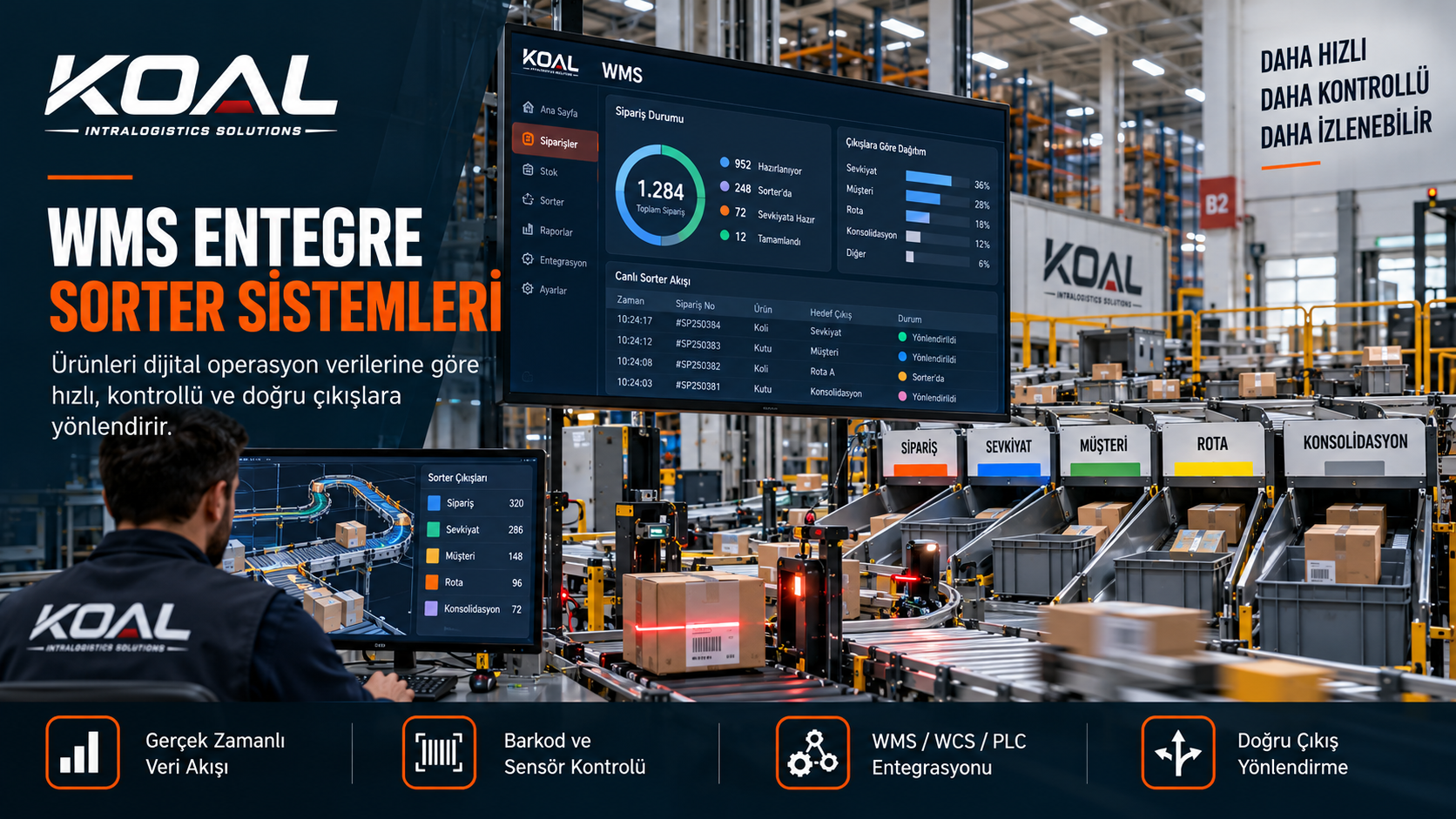
Short answer: The product barcode is read in WMS integrated sorter, the sorter control software receives the target corresponding to this barcode from WMS, directs the product to the relevant output and reports the result back to WMS. Unreadable products go to a separate reject line.
What is WMS Integrated Sorter Systems?
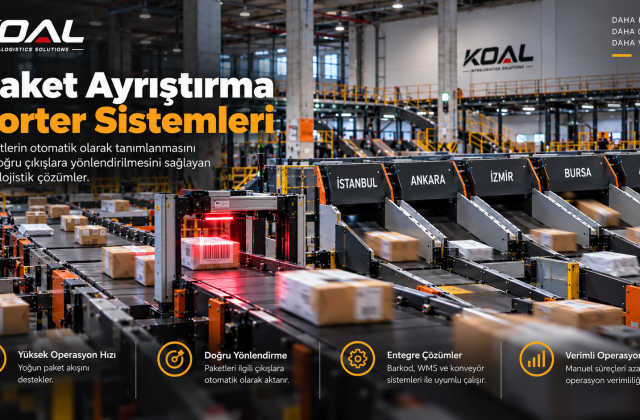
WMS Integrated Sorter Systems are intralogistics automation solutions that combine warehouse management software and automatic product sorting technologies and enable the routing of parcels, packages and products according to digital operation data. Correct management of product movements in e-commerce warehouses, logistics centers, cargo facilities and distribution centers is important for operational efficiency. Sorter systems integrated with WMS help automatically sort products according to order, customer, route or shipment information. In modern warehouse automation, sorter equipment does not only perform mechanical sorting. It can work with barcode readers, sensors, conveyors, PLC control systems and warehouse management software. WMS Integrated Sorter Systems support the management of warehouse operations in a more controlled and traceable manner by enabling physical product movements to be tracked through software.
How Do WMS Integrated Sorter Systems Work?
The working process of the system starts with the product being taken into the sorter feeding line. As the product moves on the conveyor, it is detected through barcode readers or appropriate identification technologies. The resulting product ID is matched with records in the warehouse management system. WMS provides the necessary operational data to determine which order, customer or shipping point the product belongs to. This information can be transferred to sorter automation directly or via intermediate control software such as WCS. PLC and sorter control system follows the physical location of the product and performs the routing process at the relevant exit point. Thanks to WMS Integrated Sorter Systems, the movement that occurs after the sorting process of the product is completed can be reported back to the software system. Thus, the operation stage of the product can be digitally tracked.
Why is WMS and Sorter Integration Important?
While warehouse management systems manage order, stock, location and shipment data, sorter systems perform physical product movements. The independent operation of these two structures may increase the need for manual data control and routing. WMS Integrated Sorter Systems help automate operations by associating target information in warehouse software with physical sorting processes.
- It supports automatic routing of products according to order information.
- It can reduce the need for manual parsing and data checking.
- It enables digital monitoring of product movements.
- It helps reduce the risk of being directed to the wrong exit.
- Supports data integrity between warehouse and shipping processes.
- It facilitates reporting of operational performance.
- It contributes to a more controlled management of high order volumes.
Which Sorter Technologies Are Used in WMS Integration?
When choosing sorter technology, product dimensions, weights, packaging features, target number of exits and hourly operation capacity should be evaluated. WMS integration can be applied to different sorter technologies; However, the mechanical structure and control requirements of each system may be different.
Cross Belt Sorter
Cross Belt Sorter is one of the sorting technologies that allows products to be transferred to different outlets via independent conveyor belts. It can be used in high-volume e-commerce and distribution operations with target information received via WMS.
Linear Cross Belt Sorter
Linear Cross Belt Sorter supports automatic product sorting in facilities where linear system layout is suitable. Directions can be made to different exits in line with the order or shipment data coming from the warehouse software.
Wheel Sorter
Wheel Sorter enables the transfer of parcels and packages with suitable base structure to different conveyor lines, thanks to its wheel mechanisms that can change direction. It can be used in automatic routing operations by associating with WMS data.
Tilt Tray Sorter
Tilt Tray Sorter is one of the sorter technologies in which the products move on carrier trays and are sorted at the designated exit point.
Using WMS Integrated Sorter in E-Commerce Warehouses
In e-commerce warehouses, many orders for different customers are prepared at the same time. Products must be transferred to the right points during the collection, consolidation, packaging and shipment stages. WMS Integrated Sorter Systems support automatic sorting of products using order information from warehouse management software. Products coming from different collection areas can be identified using barcode readers. In line with the target information received via WMS, products can be directed to the relevant order consolidation or packaging areas. In this way, the need for manual sorting can be reduced and order preparation processes can be progressed in a more controlled manner.
WMS Integration in Cargo and Distribution Centers
In cargo and distribution centers, packages belonging to different cities, regions, branches and shipping routes must be sorted in a short time. In high-volume transfer operations, manual routing operations can cause loss of time and operational bottlenecks. WMS Integrated Sorter Systems can provide automatic routing of packages according to shipment or route information with appropriate software integration. The package identified via the barcode is transferred to the target exit specified in the system. In cargo operations WMS WMS
WMS Integrated Sorter Systems in Order Consolidation
If an order consists of more than one product located in different warehouse areas, the products must be brought together at the same point before packaging. This process is called order consolidation. WMS can determine the products of the order and the target consolidation point. Using this data, the sorter system can direct products coming from different collection areas to the relevant exits. Thus, the physical product flow can be managed automatically while the completion status of the orders is tracked through the software.
WMS Integration with Automated Storage Systems
Sorter technologies can be used together with automatic storage systems in warehouse automation. Crates or boxes removed from AS-RS Mini Load Systems can be transferred to order preparation or sorting areas via conveyor lines. Case Pallet Elevators can be included in the automation infrastructure in facilities where product transfer between different floors is required. Thanks to the coordinated operation of WMS, WCS and equipment control systems, storage, transfer and separation processes can be managed in an integrated structure.
WMS Integrated Sorter Systems in Shipment Processes
Once the order preparation and packaging processes are completed, the products must be transferred to the correct carrier, shipping route or loading gate. WMS Integrated Sorter Systems support automatic routing of packages to different exits according to shipping information. Packages coming from sorter exits can be transported to loading areas via conveyor lines. Telescopic Conveyors can be used in vehicle loading and unloading processes. In areas where more flexible transportation is needed, Accordion Conveyors can be used.
How to Provide Data Communication Between WMS and Sorter?
Data exchange between WMS and the sorter control system can be carried out via API, messaging infrastructures or industrial communication methods, depending on the software architecture of the project. When designing the integration, it should be determined which data the systems will share and which events will generate feedback.
- Product or package identification information
- Order and shipment numbers
- Target sorter output information
- Product redirect statuses
- Barcode reading and matching errors
- Exit occupancy and equipment status information
- Transaction completion and error notifications
How the system will behave in case of delay in data communication, connection interruption or incorrect target information should be defined in advance. Thus, operational safety and product traceability can be supported.
How to Plan WMS Integrated Sorter Capacity?
When determining sorter capacity, it is not enough to evaluate only the number of daily orders. Hourly product volume, peak period density, product dimensions, number of feeding lines and required output capacity should be analyzed together. Task management on the software side is also important in capacity planning for WMS Integrated Sorter Systems. Even if the sorter line has high capacity, bottlenecks that may occur in product feeding, barcode reading or output lines can limit the total operation performance.
What Should Be Considered When Choosing WMS Integrated Sorter Systems?
Mechanical equipment features and software integration requirements should be evaluated together to determine the correct sorter system. Each facility's product profile, operational intensity and existing warehouse management infrastructure are different.
- Daily and peak hour product capacity should be analyzed.
- Product dimensions, weights and packaging features should be determined.
- The required number of sorter exits must be calculated.
- Integration possibilities of existing WMS software should be examined.
- WCS and PLC control architecture should be planned.
- Barcode reader and sensor points must be determined.
- Conveyor feeding and output capacities should be evaluated.
- Scenarios should be prepared for errors that may occur in data communication.
- Maintenance and technical service access must be taken into account.
- Infrastructure suitable for future capacity increases should be created.
How to Identify the Right WMS Integrated Sorter Solution?
Cross Belt Sorter, Linear Cross Belt Sorter, Wheel Sorter, Tilt Tray Sorter and other automatic sorting technologies can meet different operational needs. Product profile, target capacity, available facility space and software integration should be evaluated together to select the appropriate technology. Correctly designed WMS Integrated Sorter Systems help manage order preparation, sorting and shipping processes in a more controlled manner by combining warehouse management software with physical product flow. A scalable automation architecture can support businesses to adapt to increasing operational volume and track product movements digitally.
You can contact KOAL Makine to get detailed information about WMS integrated sorter systems, conveyor automation and intralogistics projects. Contact via WhatsApp You can review MHI – Material Handling Industry resources for sectoral information about warehouse automation and material handling technologies.
Barcode reading and WMS data stream
- The product enters the sorter line from the feeding point.
- The barcode reader recognizes the product (with size and weight measurement if necessary).
- Sorter control software asks the barcode to WMS or cargo software and receives the target output.
- Sorter directs the product to the target output.
- The booking result is reported back to WMS; Unreadable products go to the reject line.
When choosing barcode reading technology
- Location of the barcode on the product (top, side, bottom) and number of readers
- Reading speed compatible with line speed
- Read rate for damaged or wrinkled labels
- Reject line and manual identification point for unreadable products
Frequently asked questions
How does Sorter communicate with WMS?
The sorter control software receives the target information corresponding to the read barcode from WMS and reports the sorting result back to WMS. The integration method is determined in the project according to WMS used.
What happens to products whose barcode cannot be read?
Unreadable products are directed to the reject line; Here it is defined manually and given back to the system.
Related guides: Cross belt or tilt tray? Comparison of sorter types · 10 questions when choosing a sorter system · KOAL sorter systems

Since 2010 we have designed, built, installed and serviced sorter and conveyor systems in Gebze. These articles draw on our field experience.